
“Fastest-growing area in Indore” is one of the most-searched phrases in this market, and also one of the least honestly answered. Search it and you’ll get a dozen developer blogs each naming a different neighbourhood as the obvious winner, usually the one they happen to be selling plots in. None of them show you the actual numbers behind the claim, because in most cases there aren’t any — just a locality name and a confident adjective.
We wanted an answer we could actually stand behind, so we pulled it ourselves: real listings, read on a specific date, from the three areas that keep coming up as Indore’s growth belts.
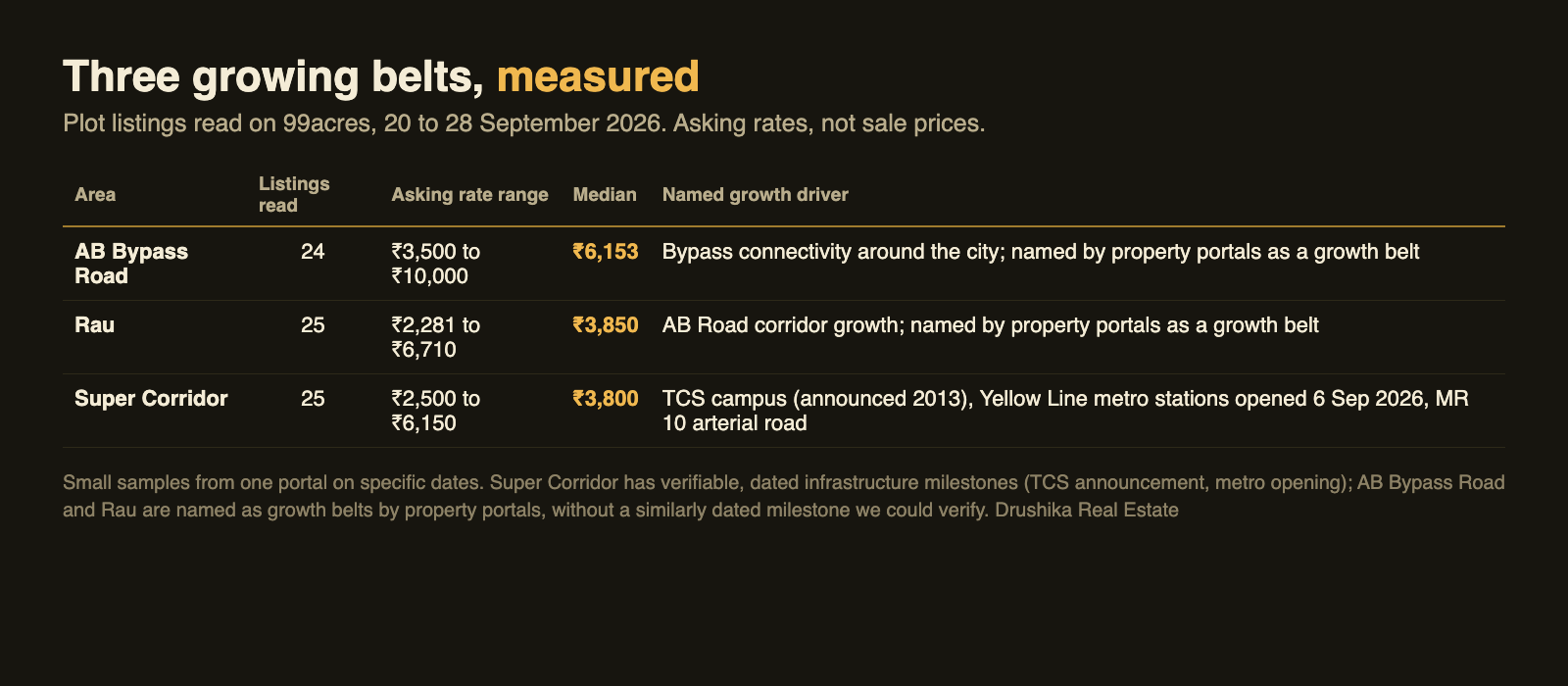
The short version: Property portals commonly name Super Corridor, AB Bypass Road and Rau as Indore’s growing real estate belts. On listings we read in September 2026, AB Bypass Road had the highest median plot rate (about ₹6,153 per sq ft), and Rau sat close to Super Corridor (₹3,850 versus ₹3,800). Of the three, only Super Corridor has a specific, dated growth driver we could independently verify.
What “growing” actually means, and the four-question test to apply before you believe it
“Fastest-growing” and “best society” are phrases built to be repeated, not checked. That’s precisely why they spread so easily across Indore property marketing — nobody wants to be the one asking a real estate agent to cite a source. But the test is simple, and worth running every time you hear the phrase, whether it’s about a locality or a specific project:
- Is there a named employer or campus attached, and do you know the date it was announced or opened?
- Is there a road or metro completion date, from an actual official source, or just “coming soon” repeated across ten listings?
- Is there real plot or price data behind it, and do you know when it was checked?
- Is there population or transaction data from a named source, or just a feeling that the area is busier than it used to be?
Super Corridor is the one of these three areas that clears that bar cleanly. TCS announced a software campus there on 10 August 2013 (TCS press release), and the Yellow Line’s Super Corridor stations opened for regular service on 6 September 2026 (Wikipedia: Yellow Line, Indore Metro). Both dated, both checkable by anyone, neither dependent on taking a developer’s word for it.
Three growth belts, measured against each other
| Area | Listings read (99acres) | Asking rate range | Median | What portals cite as the growth driver |
|---|---|---|---|---|
| AB Bypass Road | 24 | ₹3,500 to ₹10,000 | ₹6,153 | Bypass road connectivity around the city |
| Rau | 25 | ₹2,281 to ₹6,710 | ₹3,850 | Growth along the AB Road corridor |
| Super Corridor | 25 | ₹2,500 to ₹6,150 | ₹3,800 | TCS campus (2013), metro stations (opened 6 Sep 2026), MR 10 arterial road |
Read that table carefully and a slightly counterintuitive picture emerges. AB Bypass Road’s median is more than 60% higher than Super Corridor’s — which sounds like the “better” area until you consider that a higher price usually means an area is more built-out already, with less room to run, not more. Rau sits almost exactly where Super Corridor does on price, but without the same dated infrastructure story behind it, at least not one we could independently confirm. A similar price doesn’t mean a similar bet.
None of this tells you which area will actually appreciate faster over the next five years — nobody can honestly promise that. What it tells you is which claims in the marketing you’ve been reading are backed by something real, and which are just the word “growing” doing a lot of unearned work.
Even within Super Corridor, “growing” isn’t uniform
Super Corridor itself isn’t one market, which is easy to forget once you’ve accepted the locality-level story. On our own street-level read, Tigaria Badshah averaged about ₹5,150 per sq ft against Puwarda Junarda’s ₹3,700 — a roughly 39% gap inside the same “Super Corridor” label (see our full Tigaria Badshah vs Puwarda Junarda comparison). And Super Corridor as a whole still trades at a fraction of established Vijay Nagar’s rate (see Vijay Nagar vs Super Corridor), which is either the entire investment case for buying now or a sign of exactly how much ground still needs to be covered before that gap closes. Both are legitimate readings of the same number.
How to actually use this if you’re comparing areas
- Demand the dated fact behind any “growing” or “best” claim before you weigh it — not the label alone.
- Compare asking rates from the same source and the same week; blended portal averages hide very different micro-locations inside one number.
- Weigh the RERA status and layout approval of the specific project you’re considering over the reputation of the general area it sits in.
- Visit more than once, and at more than one time of day — traffic and construction dust tell you things a single afternoon visit won’t.
For plots specifically in Super Corridor, our measured plot rates and buyer checklist is the natural next stop. To evaluate a developer rather than an area, see our developer evaluation checklist.
FAQ
Which is the fastest-growing area in Indore for real estate?
There is no single, independently verified ranking of fastest-growing areas — that phrase is almost always marketing language borrowed without a source. Property portals commonly name Super Corridor, AB Bypass Road and Rau as growth belts. Of the three, Super Corridor is the one with verifiable, dated infrastructure behind it: a TCS campus announced in 2013 and Yellow Line metro stations that opened on 6 September 2026.
What is the plot rate in AB Bypass Road compared to Super Corridor?
On 99acres listings we read in September 2026, AB Bypass Road plots had a median asking rate of about ₹6,153 per sq ft across 24 listings — well above Super Corridor’s ₹3,800 across 25. A higher rate usually means a more built-out area already, not necessarily a better growth trajectory from here.
Is Rau a good area to buy a plot in Indore?
Rau’s median asking rate was about ₹3,850 per sq ft across 25 listings we read in September 2026, close to Super Corridor’s ₹3,800. What we don’t have is a Rau-specific, dated growth driver the way we have TCS and the metro for Super Corridor — check current infrastructure plans for the area yourself before treating the price similarity as an equivalent investment case.
Why do property portals call an area “growing” without giving numbers?
Because “growing” sells better than a footnote, and most readers never ask for the citation. Whenever you see the word, ask for the specific, dated fact behind it: a named employer with a date, a road or metro completion date from an official source, or price data with both a source and a date attached.
Sources
- TCS: software development campus in Super Corridor (10 August 2013)
- Wikipedia: Yellow Line (Indore Metro)
- 99acres plot listings for AB Bypass Road, Rau and Super Corridor, read 20 to 28 September 2026
Property markets change. These are asking rates from small samples on specific dates, not sale prices or valuations. This is general information, not investment advice.