
If you’re buying a residential plot in Indore’s Super Corridor and wondering whether vastu shastra should actually influence your decision, the short answer is: check the basics (facing direction, plot shape, the north-east corner) because they’re easy to verify and cost nothing, but never let vastu override the checks that protect your money — RERA registration, IDA/TNCP layout approval, and clear title. The two aren’t in competition; a good plot in Super Corridor can satisfy both.
Why Vastu Still Comes Up, Even in a “Modern” Gated Plot Development
Walk into any site office in Puwarda Junarda, Tigaria Badshah, or anywhere along Super Corridor, and vastu is one of the first three questions buyers ask — right after price and RERA status. That’s not superstition getting in the way of a rational purchase; for most Indori and Madhya Pradesh families, a plot is a one-time, multi-decade commitment, and vastu is simply part of how the decision gets made at home. Developers who understand this design main gates facing east or north, keep the north-east corner open, and build temples or meditation spaces into the common areas — not as a gimmick, but because it answers a question buyers were going to ask anyway.
The mistake we see buyers make is treating vastu as a pass/fail test that overrides everything else — walking away from a well-located, RERA-registered plot with clean title over a facing direction, while ignoring an unregistered project with a “perfect” vastu chart. Vastu is a layer you check. It is not a substitute for due diligence.
The Vastu Basics a Plot Buyer in Super Corridor Should Actually Check
You don’t need to hire a vastu consultant to do a first-pass check on a plot. Most of what matters is visible on the layout map and confirmable with a site visit. Here is what the common vastu guidance actually says about facing direction, and what we’d tell you to verify on the ground instead of taking a brochure’s word for it.
| Plot Facing | Common Vastu View | Buyer Suitability | What to Verify On-Site |
|---|---|---|---|
| North-East | Considered the most auspicious; the “Ishanya” corner | Widely preferred, often priced at a premium | Confirm the NE corner is actually open and at the lowest level, not occupied by a water tank or boundary wall |
| East | Favourable; associated with morning sun and the Sun deity | Strong all-round choice | Check if land slopes toward NE and the main gate is genuinely on the east road |
| North | Favourable; linked to wealth and prosperity | Good choice, usually easier to find | Verify the main door position in the sanctioned layout, not just the sales render |
| South or West | Considered less ideal by traditional vastu, though not inauspicious | Workable with layout adjustments inside the building | Ask your architect about internal room placement rather than rejecting the plot outright |
| Irregular / cut corner | Generally discouraged regardless of facing | Avoid where possible | Get the exact plot shape and dimensions from the registered layout plan, not a rounded sketch |
A practical note: these are vastu conventions, not building-code requirements. Madhya Pradesh’s building bylaws, IDA layout norms, and your structural engineer’s advice take precedence whenever the two conflict. Treat the table above as a preference filter, not a disqualifying test.
Plot Shape, Slope and the North-East Corner Rule
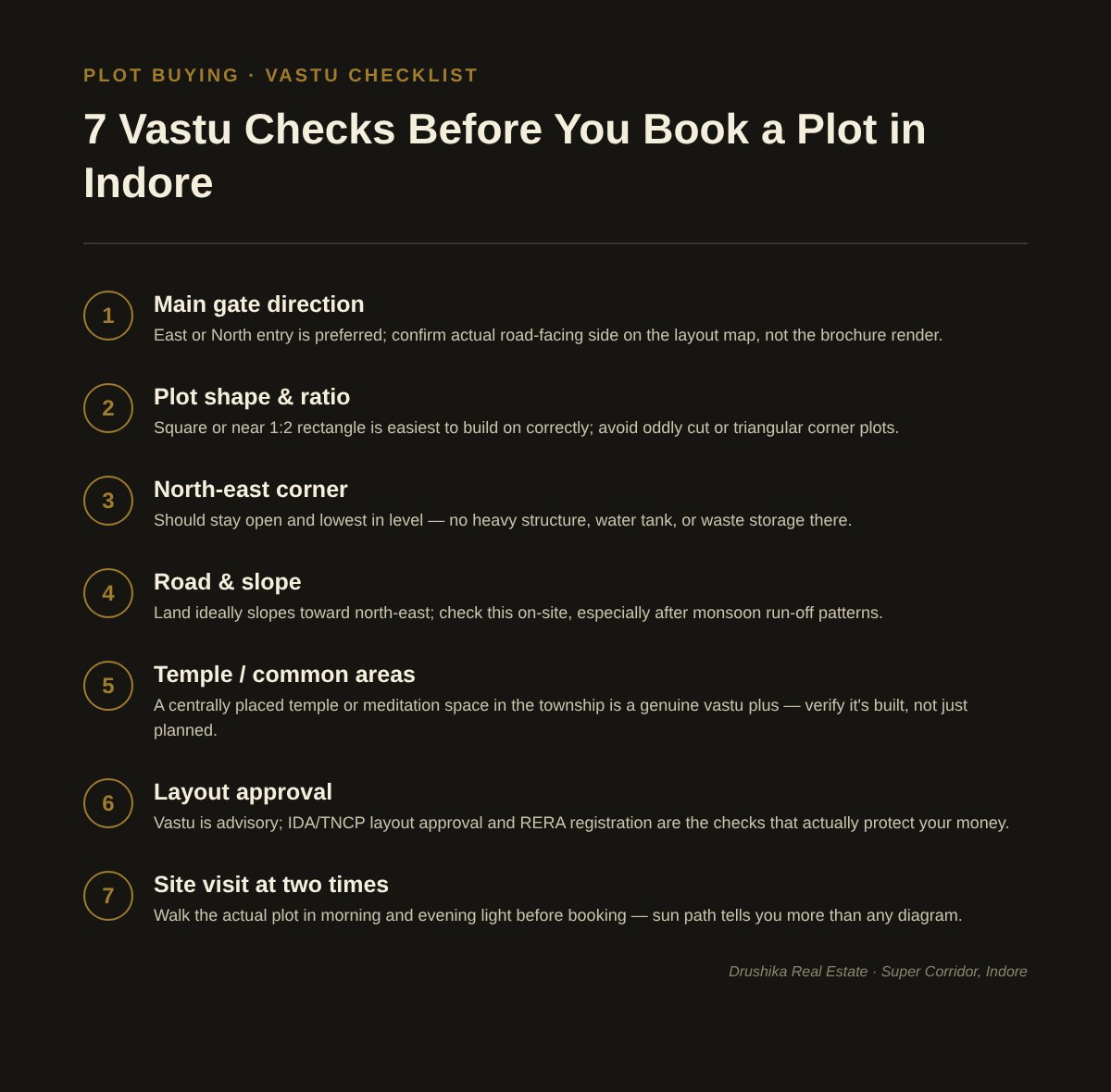
Beyond facing direction, three things come up repeatedly in vastu guidance for plots, and all three are things you can actually inspect:
- Shape and ratio: a square plot, or a rectangle close to a 1:2 ratio, is considered easiest to plan correctly. Irregular, triangular, or heavily cut-corner plots are typically avoided, independent of price.
- Slope: land that gently slopes toward the north-east is preferred, since it’s believed to direct water and energy favourably. On a real site, this also has a practical benefit — it affects drainage after Indore’s monsoon months.
- The north-east corner itself: this zone is meant to stay the most open and lightest part of the plot. Avoid plots where the NE corner is already committed to a transformer, a neighbouring boundary wall, or a sewage line in the layout.
None of this requires faith to act on — it requires asking for the sanctioned layout map and actually walking the plot boundary before you pay a token amount.
What a Developer Can Build Vastu-Friendly — and What’s On You
A developer controls the township-level layout: where the main gate sits, how internal roads are drawn, where common amenities go, and whether individual plots come out square or compromised. A buyer controls what happens inside their own plot boundary — house design, room placement, and interior layout.
Drushika Paradise Grande, our plotted development at Puwarda Junarda on Super Corridor (RERA No. P-OTH-25-5339), is a useful example of the township-level side of this. The project’s amenity set includes a temple within the common area, a yoga and meditation deck, landscaped gazebos, and an open garden — alongside the more conventional list of a kids’ play area and a gym. The project is positioned by the developer as a vastu-oriented layout, which in practice means the common infrastructure (gate placement, open spaces, the temple location) was planned with these principles rather than retrofitted later.
That said, a vastu-conscious township layout doesn’t automatically make every individual plot inside it ideally facing or perfectly square — corner plots, park-facing plots, and interior plots will still vary. If facing direction matters to your family, ask for the specific plot number’s orientation on the master plan before booking, not just the project’s overall positioning.
Vastu vs Legal Due Diligence: Don’t Confuse the Two
This is where we see buyers go wrong most often: spending weeks debating a facing direction while skipping the checks that actually determine whether the plot is safe to buy at all. Vastu is a preference. The items below are not optional.
| Check | Type | Why It Matters |
|---|---|---|
| Plot facing & shape | Vastu (preference) | Affects buyer comfort and, in some cases, resale appeal to vastu-conscious buyers |
| RERA registration number | Legal (mandatory) | Confirms the project is registered with MP RERA; verify it directly on the RERA portal rather than trusting a brochure |
| IDA / TNCP layout approval | Legal (mandatory) | Confirms the colony layout itself is sanctioned, not just marketed |
| Title and encumbrance | Legal (mandatory) | Confirms the land is free of disputes or pending loans before registry |
| North-east corner openness | Vastu (preference) | A planning nicety, not a safeguard against fraud or disputes |
| Possession and development timeline | Commercial (important) | Confirms roads, boundary wall and amenities are actually built, not just planned |
If you only have time to verify two things before paying a token amount, make them RERA registration and layout approval — not facing direction.
Why the Super Corridor Location Still Outweighs Any Single Vastu Rule
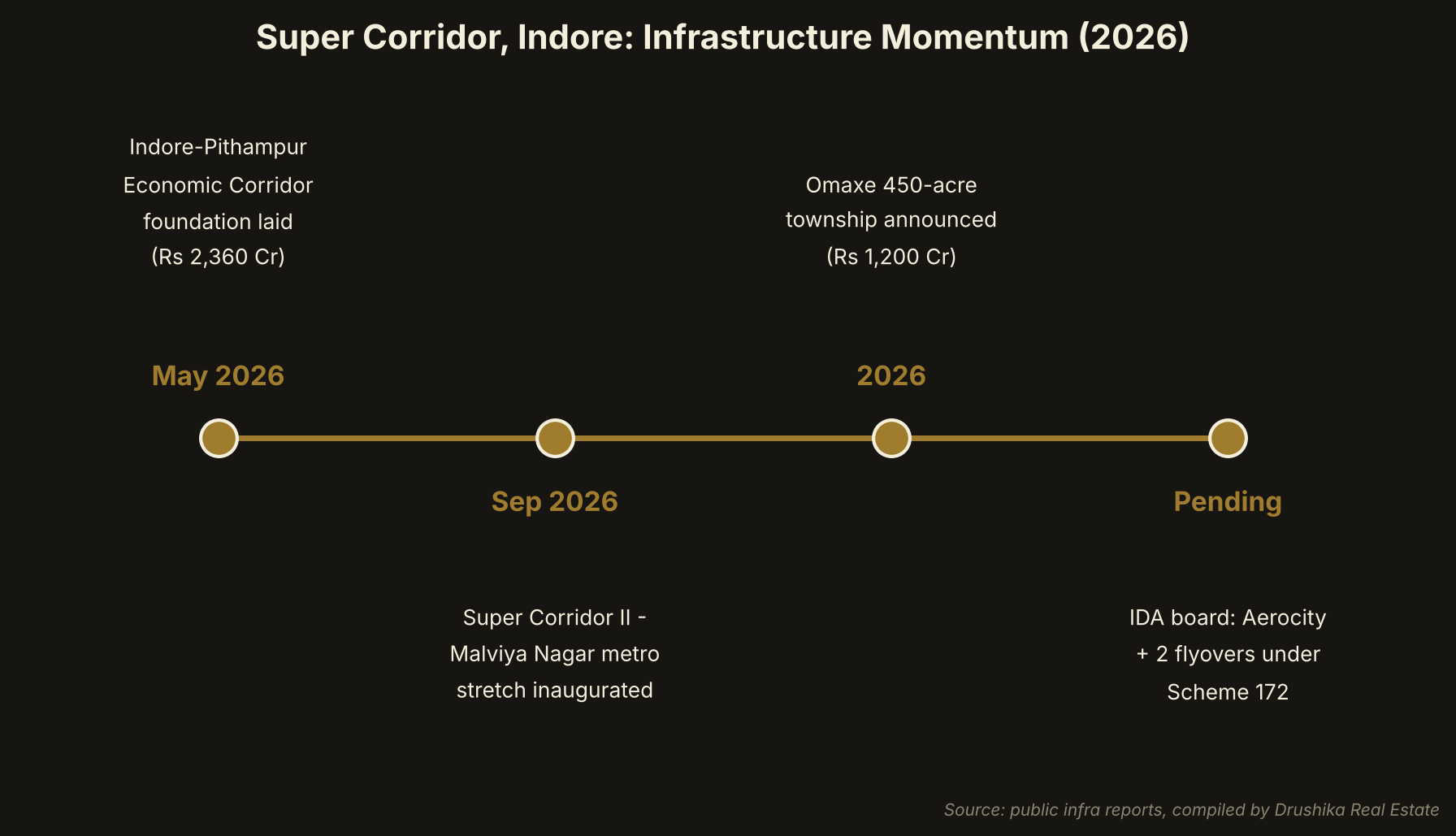
Here’s the context that matters more than any individual vastu point: Super Corridor’s underlying infrastructure case has only strengthened through 2026. The Indore Metro’s Super Corridor II – Malviya Nagar stretch was inaugurated in September 2026, the Rs 2,360 crore Indore–Pithampur Economic Corridor had its foundation laid in May 2026 to link the airport-side Super Corridor to Pithampur, and Omaxe’s move to develop a 450-acre, Rs 1,200 crore township along the same stretch is a signal that larger developers are underwriting the location’s long-term demand, not just smaller plotted-colony builders. The Indore Development Authority has also been pushing Aerocity and flyover proposals for the belt under Scheme 172.
None of this is vastu. It’s roads, metro, and capital — the things that actually move resale value and rental demand over a 5–10 year hold, which is the realistic horizon for most plot buyers. A well-located, RERA-registered, reasonably vastu-friendly plot in a corridor with this much active infrastructure spend will outperform a “perfectly” vastu-aligned plot in a stagnant micro-market, every time. Location and legal compliance are the floor; vastu is the finish.
Common Vastu Myths That Cost Buyers Good Plots
- “South-facing plots are always bad.” South and west-facing plots are considered less ideal by some traditions, but can be corrected significantly through internal house design — room placement, entry point within the plot, and layout of the staircase. Many architects in Indore routinely design well-functioning south-facing homes.
- “A slightly irregular plot has no fix.” Minor irregularities can often be managed in the building footprint, leaving an open, regular garden or utility area to absorb the cut corner.
- “Vastu certification from the seller is proof enough.” There’s no statutory “vastu certificate” the way there is a RERA registration number. Treat any such claim as a sales pitch and verify the layout yourself or with an independent consultant.
- “Township-level vastu guarantees the exact plot you buy is vastu-compliant.” As noted above, this isn’t automatic — always check your specific plot’s position and facing on the master layout.
Frequently Asked Questions
Is vastu important when buying a plot in Indore?
For many buyers in Indore and Madhya Pradesh, yes, it’s an important preference check — facing direction, plot shape and the north-east corner are commonly reviewed. But it should sit alongside, not instead of, legal checks like RERA registration and IDA layout approval.
Which facing is best for a residential plot as per vastu?
North-east and east-facing plots are generally considered the most favourable in traditional vastu guidance, followed by north-facing plots. South and west-facing plots are workable with adjusted internal house design.
Does Drushika Paradise Grande have vastu-compliant plots?
Drushika Paradise Grande in Puwarda Junarda (RERA No. P-OTH-25-5339) is positioned with a vastu-oriented township layout, including an on-site temple, meditation deck and open garden. Facing direction varies by individual plot, so ask for your specific plot’s orientation on the master layout before booking.
Can a south-facing plot still be a good investment in Super Corridor?
Yes. Location fundamentals — RERA registration, connectivity, and the pace of infrastructure development in Super Corridor — typically matter more to long-term value than facing direction alone, and a south-facing plot can be designed around effectively by an experienced architect.
If you’d like to see plot-wise orientation and availability at Drushika Paradise Grande or any other Drushika project in Super Corridor, get in touch with our team here.