
Short answer: A plot generally offers stronger long term appreciation potential and near zero ongoing maintenance cost, since its value tracks the land itself rather than a structure that ages, while a flat offers immediate usability, rental income from day one, and simpler financing and legal diligence. Neither is universally better, the right choice depends on whether you need income and convenience now or are optimizing for appreciation over a longer horizon.
This is one of the most common questions buyers ask before entering the Indore market, and it deserves an honest, comparative answer rather than a one sided pitch for either option. Here is what genuinely differs between the two, and what that means specifically for a buyer looking at the Super Corridor.
What actually differs between a plot and a flat as an investment
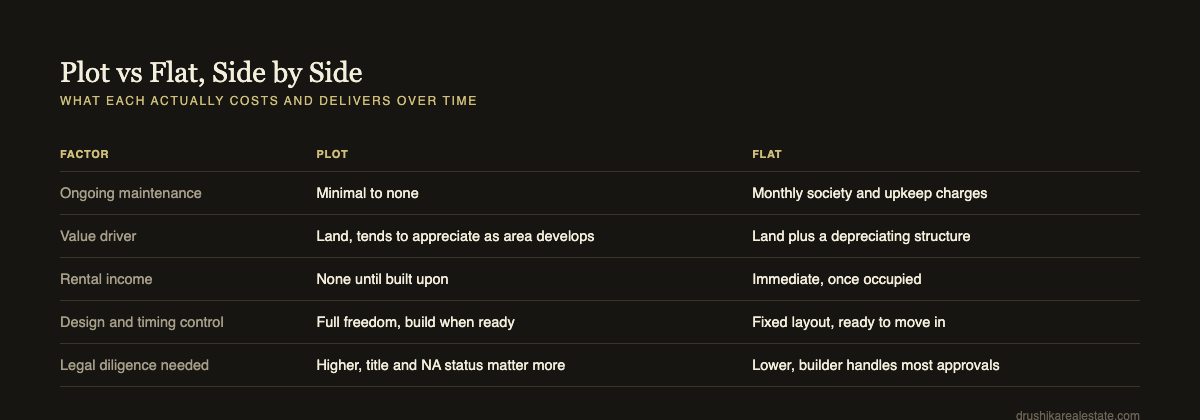
| Factor | Plot | Flat |
|---|---|---|
| Ongoing maintenance | Minimal, no society or upkeep charges | Recurring monthly charges for security, common areas, and amenities |
| What drives long term value | The land itself, which does not physically depreciate | Land plus a structure that ages and requires eventual repair or renovation |
| Rental income | None until you build on it | Available immediately once occupied or leased |
| Financing | Generally requires more of your own capital upfront, lower loan to value | Simpler financing with higher loan to value ratios widely available |
The legal diligence gap on plots that flats do not carry
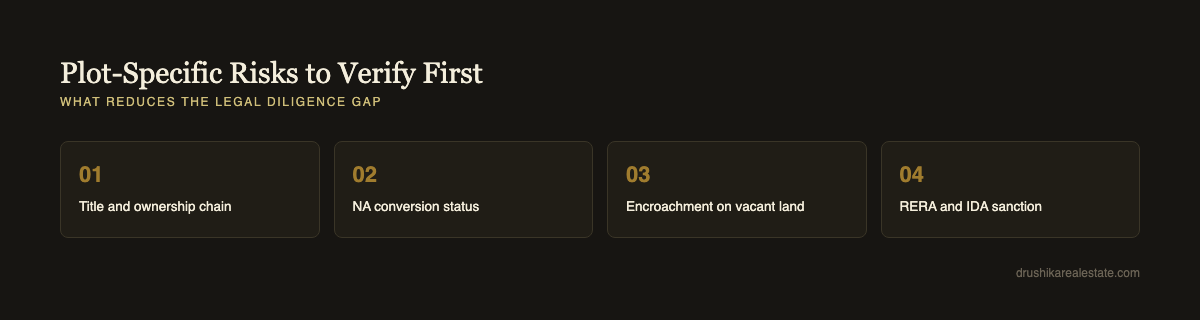
A vacant plot carries a category of legal risk a completed flat generally does not: title disputes surface more often on land than on a builder delivered unit, NA conversion status must be independently verified, and encroachment on vacant land is a real risk if the plot sits unfenced or unmonitored for long stretches. None of this makes plots a bad investment, but it does mean the diligence checklist for a plot is longer and more consequential than for a flat, where the builder has generally already handled these approvals as a condition of construction.
Why this tilts toward plots specifically in the Super Corridor
The Super Corridor’s core investment case is infrastructure driven appreciation, the Indore Metro construction and six lane road widening progressing through the area. That kind of appreciation accrues to land, not to a depreciating structure, which is why a growth corridor like this one is a more natural fit for a plot strategy than for buying a flat purely as an appreciation play. A flat here still makes sense if your priority is near term rental income or personal use, but the corridor’s own growth thesis favors land.
How to reduce plot-specific risk when buying in the Super Corridor
The diligence gap above narrows considerably when you buy into a RERA registered, IDA sanctioned layout rather than an individual unregistered plot, since the registration and sanction process independently verifies title, land use conversion, and layout approval at the project level. Drushika’s Super Corridor projects, Drushika Imperial, Paradise Grande, and The Heera Residency, are each individually RERA registered and IDA sanctioned, which addresses most of the plot-specific risk category above at the project level rather than leaving it entirely to individual buyer diligence.
Frequently asked questions
Is a plot or a flat a better investment in Indore?
It depends on your goal. Plots generally offer stronger long term appreciation potential and lower ongoing costs, while flats offer immediate rental income and simpler financing. In a growth corridor like Indore’s Super Corridor, where appreciation is driven by infrastructure development, plots tend to be the more natural fit for pure investment purposes.
Do plots have higher maintenance costs than flats?
No, the opposite. Plots carry minimal to no ongoing maintenance cost since there is no structure, society, or shared amenities to maintain, unlike flats which typically carry recurring monthly charges.
What is the biggest risk specific to buying a plot instead of a flat?
Title and land use verification. A vacant plot’s title history, NA conversion status, and encroachment risk need more diligence than a flat, where the builder has typically already secured the relevant approvals. Buying into a RERA registered, IDA sanctioned layout significantly reduces this gap.
To review RERA and IDA documentation for a plot at Drushika Imperial, Paradise Grande, or The Heera Residency, contact the Drushika Real Estate team.
Pingback: Best Plots in Super Corridor Indore (2026): Prices, RERA Checklist & Top Projects - Drushika Real Estate