
Short answer: To buy a residential plot in Indore, verify the sale deed, mother deed, and encumbrance certificate to confirm clean title, the NA order confirming the land is legally converted for residential use, the RERA registration certificate and IDA sanctioned layout plan for the project, and recent property tax receipts. Missing any one of these is a reason to pause before booking, not a detail to sort out later.
Most disputes over plot purchases trace back to a document that was never actually checked before money changed hands, not to something newly discovered after possession. This is the full checklist, in the order it actually matters, for anyone buying a residential plot in Indore.
The document checklist
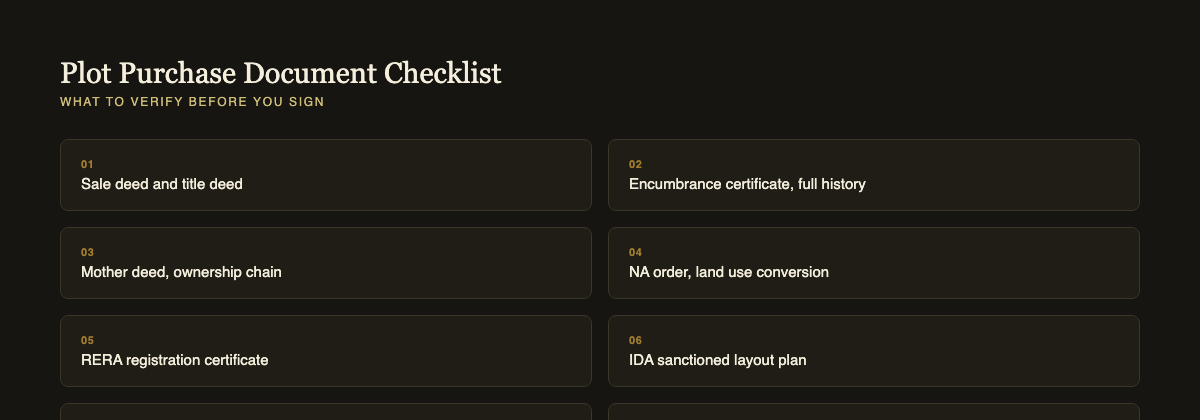
| Document | What it proves | Where to get it |
|---|---|---|
| Sale deed / title deed | Legal ownership and transfer of the property | Seller or developer, verify at sub registrar office |
| Mother deed | Full ownership chain back to the original title | Seller or developer’s legal file |
| Encumbrance certificate | No pending loans, liens, or litigation on the land | Sub registrar office, request full period coverage |
| NA order | Land is legally converted from agricultural to residential use | Revenue department records |
| RERA registration certificate | Legal disclosure, possession timeline, refund protection | Developer, verify on rera.mp.gov.in |
| IDA sanctioned layout plan | Roads, drainage, and plot boundaries meet planning standards | Developer, cross check with IDA records |
| Property tax receipts | No pending dues from prior ownership, last 3 years | Municipal corporation |
| Mutation and municipal records | Ownership correctly updated in local records | Municipal corporation |
The two documents buyers skip most often
The encumbrance certificate and the NA order are the two most commonly skipped, usually because a broker or developer assures the buyer they are “not necessary” for a new plotted development. Both remain necessary. The encumbrance certificate is the only document that confirms the land is not already pledged against a loan or tied up in a dispute you cannot see just by visiting the site. The NA order matters because agricultural land that has not been properly converted cannot legally be sold as residential plots, regardless of how the layout is marketed.
What a RERA registered, IDA sanctioned project simplifies
Buying into a project that is already RERA registered and IDA sanctioned, such as Drushika Imperial or Drushika Paradise Grande in the Super Corridor, does not remove the need to check these documents, but it significantly narrows what you are verifying. The NA order and IDA sanction are already handled at the project level; your own diligence then focuses on confirming your specific plot’s sale deed, that the RERA number is genuinely registered to this project, and that property tax and mutation records are current.
Frequently asked questions
What is the most important document when buying a plot in India?
The sale deed and the encumbrance certificate together, since the sale deed establishes legal ownership and the encumbrance certificate confirms the land carries no hidden loans, liens, or disputes.
Do I need an NA order if I am buying in a plotted development?
Yes. The NA order confirms the underlying land has been legally converted from agricultural to residential use. Without it, the land cannot legally be sold as residential plots regardless of how developed the layout looks.
How far back should an encumbrance certificate go?
Request one covering the full period of ownership up to the present date, not just the last few years, so any historical lien or dispute would be captured.
To review the RERA and IDA documentation for a specific Drushika project, contact the Drushika Real Estate team.
Pingback: Best Plots in Super Corridor Indore 2026: Prices & RERA Checklist
Pingback: Plot Registration Process in Indore 2026: Step by Step
Pingback: Drushika Real Estate Indore: Projects & RERA Numbers